
How to Make a Patchwork Tablecloth: Step by Step
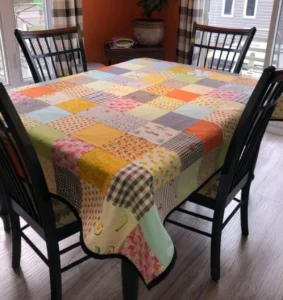
Patchwork tablecloths are a charming and versatile option for any occasion. By combining colorful scraps of fabric, you create a unique piece that reflects your style. Follow this simple guide, even if you’re a beginner.
Materials needed:
• Fabric scraps (set of 20–40 squares of 10 cm x 10 cm or as desired size)
• Lining fabric (optional, for firmness)
• Scissors or rotary cutter
• Metal ruler
• Threads matching the fabrics
• Straight stitching algebra
• Sewing machine (or hand sewing needle)
• Pins
• Measuring tape
• Ironing board and iron
• Optional: quilted lining fabric for extra fuzz
Recommended size:
• Standard size for a 6-8 seater table: 150 cm x 240 cm (with a 5–8 cm margin around for gathering or adjusting)
• If you prefer a smaller rectangular shape: 140 cm x 180 cm
Choosing the patchwork pattern:
• Patchwork squares: cut small equal squares (10 cm x 10 cm) and arrange them in a mosaic pattern.
• Free-form patchwork: combine various shapes (triangles, rectangles) for a more modern look.
• Color palette: choose 3 to 5 complementary colors, keeping some neutral tones for balance.
Cutting the patches:
• Wash and iron all pieces before cutting to avoid future shrinkage.
• Cut all patches to the defined size. Success depends on the consistency of the squares/rectangles.
Assembling the patchwork:
• Arrange the patches on a flat surface, forming the desired layout.
• Separate by rows (columns) to facilitate sewing.
• Iron the patches between the seams to set the folds.
Sewing the pieces:
• Join the patches in vertical lines:
o Position two patches with the right sides facing up.
• o Sew with a 1/4 inch (~0.6 cm) seam allowance.
• o Press the seam open to set it.
• o Repeat until each complete row is formed.
• Join the vertical lines together to form the complete patchwork panel.
• Check for distortions; if necessary, adjust with an iron.
Panel Finishing:
• Cut the patchwork panel to the exact size of the desired towel (with an extra 2 cm for the hem).
• If desired, attach a lining for firmness: align the lining with the patchwork and pin it in place.
Hem:
• Fold the edge 1 cm, pin, and then fold another 1 cm inwards.
• Iron to set the fold.
• Sew by hand or machine close to the fold for a clean finish.
• Make a uniform hem around the entire towel.
Final Ironing:
• Iron the entire towel around to remove creases and leave the finish ready for use.
• Useful Tips
• Pre-wash fabrics to prevent shrinkage.
• Use sewing basting stitches to keep the pieces straight.
• Try a decorative border (decorative stitches, topstitching in contrasting colors) to add personality.
• If you want an extra touch, add an outer border with plain fabric around the tablecloth to highlight the patchwork.
Patchwork Tablecloth Care
• Wash in cold or lukewarm water with mild soap.
• Avoid bleach, which can fade colors.
• Dry in the shade to preserve colors.
Conclusion:
With patience and a little creativity, you can transform ordinary scraps into a charming, patchwork-style tablecloth. This project not only beautifies the table but also offers an opportunity to reuse fabrics you love.